

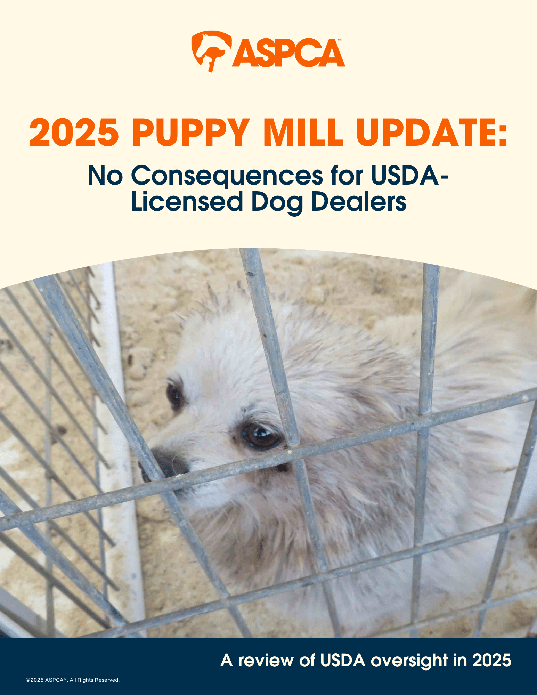
The ASPCA just released our 2025 report that looks at how the USDA is enforcing the Animal Welfare Act — the law that was designed to protect dogs in puppy mills. The results: 2025 was a good year to be a bad puppy mill but, once again, a terrible year to be a dog trapped in a puppy mill. The USDA’s long history of weak enforcement and hands-off policies took an even further downturn. Despite documenting horrific conditions and suffering dogs, the USDA pursued zero cases against puppy mill operators who were violating the law.
Commercial breeders who hold large number of breeding dogs and sell their puppies wholesale to pet stores, for research or online are required to provide basic care to their animals — a plan for veterinary treatment when animals are sick or injured, an enclosure that is big enough to allow them to turn around in, clean food once a day, access to water and, since breeding dogs are typically kept in barns or outhouses, protection from cold or heat.
The U.S. Department of Agriculture (USDA) is responsible for ensuring dogs held in commercial breeding facilities are given this minimal care, but the agency fails to protect these vulnerable dogs. Inspections are infrequent, incomplete or inconsistent, and the agency has relied on ineffective programs aimed at “helping” commercial breeders comply with the law instead of abiding by it. This long history of weak enforcement and hands-off policies took an even further downturn in 2025. Despite documenting horrific conditions, the USDA pursued zero cases. The result — once again — is hundreds of thousands of dogs are exploited and harmed every year solely for profit.
Our newly released report [PDF] found that in 2025, USDA inspectors saw dogs suffering from illnesses and injuries without veterinary care, fed moldy food, given no access to water and living in kennels infested with roaches and rodents. All these violations were at commercial facilities operating under USDA licenses.
Despite the agency’s responsibility to enforce the law by issuing fines, denying or revoking licenses and their authority to remove suffering dogs, we found time and time again, nothing happened. The USDA documented over 680 violations between September 2024 and October 2025 and likely observed or had knowledge of many more. Yet every commercial breeder was allowed to keep their USDA license, not a single fine was imposed and every suffering dog — the emaciated, hurt and sick — was left right where they were.
See the full report [PDF]
Following a year of deep staff cuts at the USDA, the Department of Agriculture Secretary Brooke Rollins and Attorney General Pam Bondi recently made a public commitment to fight puppy mill cruelty. While the details of these efforts are still forthcoming, we hope the findings in this report [PDF] serve as a further catalyst for positive reform.
Goldie’s Act (H.R. 349) is critical legislation that would strengthen the USDA’s enforcement of the Animal Welfare Act to address and correct problems that continue to jeopardize hundreds of thousands of animals around the nation. Businesses and organizations who benefit from the USDA’s lax enforcement, notably the American Kennel Club, have fought Goldie’s Act and other federal bills aimed at improving conditions at USDA-licensed facilities, keeping these bills from progressing. Contact your members of Congress and tell them to support Goldie’s Act to protect dogs who are suffering — and even dying — in cruel puppy mills.