

Throughout 2026, the ASPCA is sharing highlights from our organization’s rich and sometimes unexpected 160-year history.
This week is National Poison Prevention Week, an annual observance established by Congress in 1961 to raise awareness of the dangers of poison and how to prevent harmful exposures. Animal poison prevention came later, in the late-1960s and early-1970s, the brainchild of Dr. William Buck, a pioneer in veterinary toxicology at Iowa State University College of Veterinary Medicine. Dr. Buck later joined the University of Illinois College of Veterinary Medicine and launched the first Animal Toxicology Hotline in 1978.
That hotline, today known as ASPCA Poison Control, is the nation’s leading resource for animal-related toxicology. It was acquired by the ASPCA in 1996 and remains allied with the University of Illinois. The 24/7 veterinary toxicology resource offers lifesaving support for poison-related emergencies by calling (888) 426-4435.
Nearly 70% of U.S. households own at least one pet, according to the American Veterinary Medical Association, with the total pet population approaching 400 million, including roughly 90–100 million dogs and 75–95 million cats. It’s no wonder, then, that the ASPCA Poison Control staff handles about one call every 53 seconds.
“Animals get into a lot of mischief,” says Jackie Klonowski, who manages the office’s operations. She should know: In 2025, ASPCA Poison Control staff helped more than 334,000 animals with toxic substance exposures involving pesticides, drugs, plants, household products, harmful foods and other potentially hazardous items. It has a staff of more than 200 veterinary professionals, including over 50 veterinarians, many of whom are board-certified in veterinary toxicology and/or general toxicology — the largest number of veterinarians board-certified in toxicology in the industry — and nearly 100 licensed veterinary technicians supported by veterinary assistants.
The achievements of ASPCA Poison Control are owed to our staff’s compassion and deep expertise in helping pet owners recognize and effectively respond to potential emergencies.
In 2007, the ASPCA led the response to the most extensive pet food recall in U.S. history and supported federal legislation to make pet food safer. By July 2025, ASPCA Poison Control had handled its 5 millionth case, involving a small dog suspected of eating raisins.
In 50-75% of cases, our experts determine that a pet can be safely managed at home when exposure is not severe. In critical situations, we collaborate with pet owners’ veterinarians to ensure they have the information needed for effective treatment.
“What we learn influences and advances the fields of veterinary toxicology and animal welfare, which is our goal,” says Mindy Perez Meadows, senior vice president of ASPCA Poison Control. “We freely share our research and discoveries.”
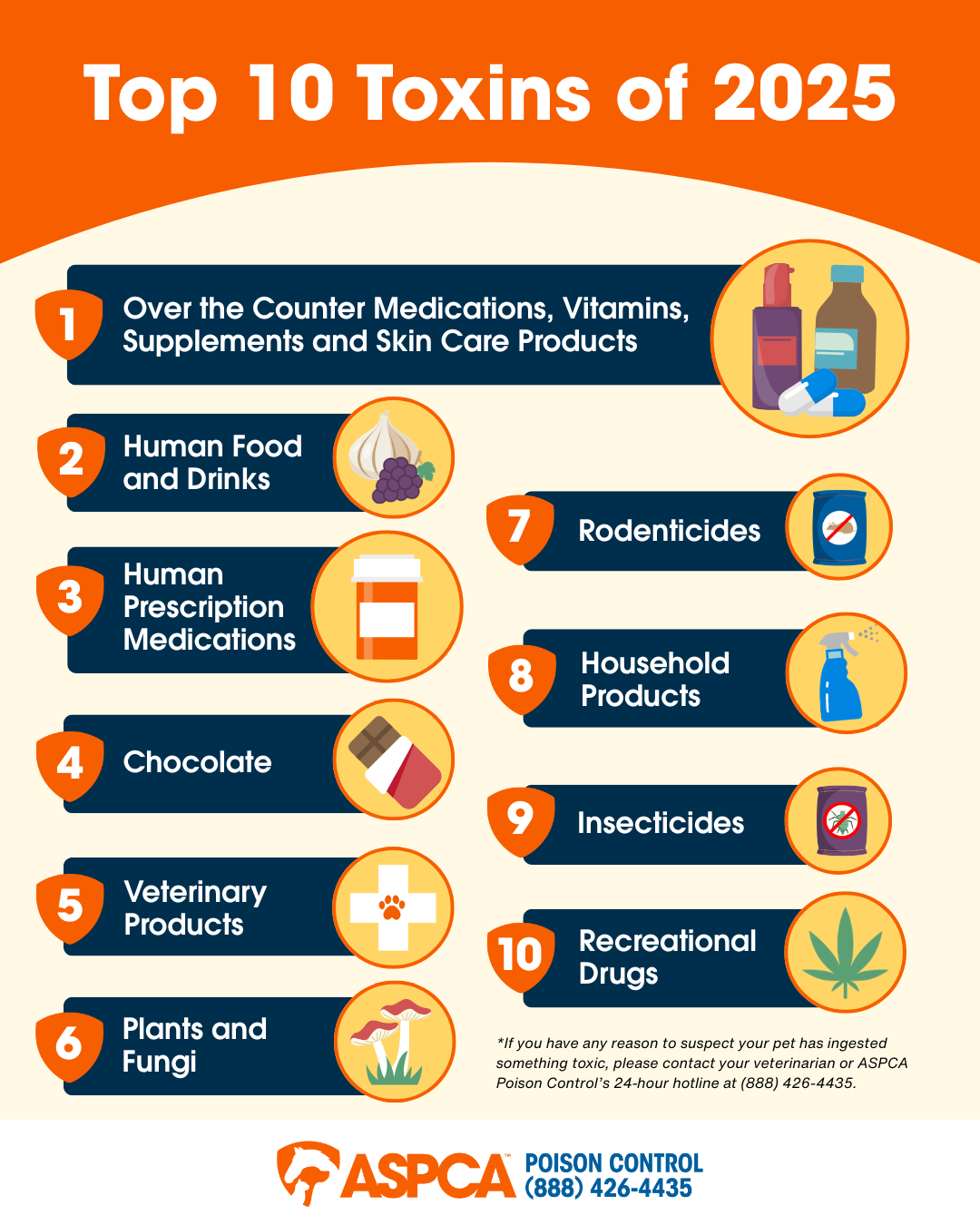
Information about poison control and toxic hazards consistently ranks among the most popular concerns for pet owners and pet lovers. Every year, ASPCA Poison Control compiles case data to determine the Top 10 Toxins pets encounter — the top three usually being over-the-counter medications, human food and drinks and human prescription medications.
A query with ASPCA Poison Control’s toxicology team revealed that none of the products in the slideshow at the top are still on the market except for Fels-Naptha® soap, which changed its formulation in the 1960s. Other products have also changed over time. In the 1950s, for example, many paints still contained lead, which is not the norm today. Roach baits and insecticides have also evolved to contain less-toxic ingredients.
Reviewing past editions of ASPCA magazines shows how far pet-poison care has come. In a column in the Fall 1956 edition of ASPCA Animal Protection, Dr. Norman Johnson of the ASPCA Hospital and Clinic described treatments for animals poisoned by common household hazards, such as rat or roach powders and paint fumes, and recommended egg whites to induce vomiting in cats.
“Egg whites are not, nor were they ever, appropriate,” says Meadows. “But today, 70 years later, pet owners have ASPCA Poison Control as a resource, and we offer scientific and evidence-based guidance.”
ASPCA Poison Control is your best resource for any animal poison-related emergency. If you think your pet may have ingested a potentially poisonous substance, call (888) 426-4435. A consultation fee may apply.
A dip into the ASPCA archives from the end of the 19th century reveals that animal poisoning was a serious problem. In 1889, ASPCA President John P. Haines offered a $25 reward for information leading to the arrest and conviction of anyone guilty of poisoning animals, and posters were distributed throughout New York State.
“The cowardly offence of dropping small pieces of meat or bread impregnated with poison, with the intent that it should be eaten by a neighbor's cat or dog, out of revenge or for some fancied wrong, has given the Society much trouble,” reads the ASPCA 1889 Annual Report. “Many animals have thus been subjected to prolonged suffering and death.”
In a 1904 New York case, 10 horses belonging to one person were poisoned; five of them died. The suspect, Israel Felman, was placed on trial, but none of the witnesses could testify that he committed the acts.
In 1937, New York City and national media outlets profiled a wealthy widow named Juliet Tuttle, also known as Mrs. Charles A. Tuttle, possibly the most infamous poisoner of pets in U.S. history. She hunted down dogs and cats in New York City and its suburbs, snuffing them out with poison. The one-time chair of the New York Women’s League for Animals, an organization that raised funds for the city’s largest animal hospital — known today as the Schwarzman Animal Medical Center — Mrs. Tuttle is also listed as an ASPCA member and contributor in ASPCA Annual Reports throughout the 1920s and maintained her support of additional humane societies in Westchester County (New York) and Connecticut.
As she climbed the social ladder and devoted herself to animal welfare groups, Mrs. Tuttle was breaking many of the city’s animal-protection laws, which, thanks to ASPCA founder Henry Bergh, were the most advanced in the country. When she went on trial in Eastchester, New York, for poisoning several dogs, 28 witnesses testified against her, including a former chauffeur, who said Tuttle used cyanide-tainted meatballs to kill dogs and chloroform to knock out cats. Mrs. Tuttle, 65, denied many of the allegations, though she admitted to “mercifully” killing cats, whom she said were “carriers of disease and a disgrace to humanity.” The court offered the millionaire murderess the choice of a $500 fine or a year in jail. She paid the fine.
In the early 1940s, authorities in Westchester County warned that a dog poisoner was again on the loose. It was reported that “an elderly woman…tried to coax animals up to her car and drove away hurriedly when detected.” The Westchester County S.P.C.A. offered a $25 reward for an arrest and conviction, but to no avail. Mrs. Tuttle, whose ASPCA membership appears to have lapsed after 1930, receded from view.
Related stories in this ASPCA 160 series:
Championing Spay/Neuter Helped Define ASPCA in the 20th Century and Beyond